
Robotics vs Coding for Kids: Why I Keep Telling Parents to Start With the Robot
RoboAiQ Editorial · Editorial Team · Published 1 June 2026
Written by RoboAiQ's editorial bench — working electronics engineers and the instructors who teach the classes.
I've sat across from enough parents to know the question coming before they finish the sentence. "Should we do coding or robotics?" Both feel right. Both show up on the same enrichment websites. Both claim to teach problem-solving and logical thinking and three other phrases that mean nothing without context.
Here's my actual answer, after years of watching kids learn both: start with the robot. Not because coding doesn't matter — it does, enormously — but because a robot has one quality a screen doesn't. It refuses to lie to you.
The problem with screen-only coding for young kids
Watch a nine-year-old use a coding app. The blocks move. The character jumps. A certificate appears at the end of level four. The child feels accomplished. The parent feels accomplished.
Now ask the child, a week later, what they built. Watch the answer.
The apps are well-designed. They teach sequence and logic and loops. But they teach it in a world with no consequences. A wrong instruction in Scratch makes a cat slide sideways. A wrong instruction to a robot makes the robot drive into a wall. These are not equivalent learning experiences.
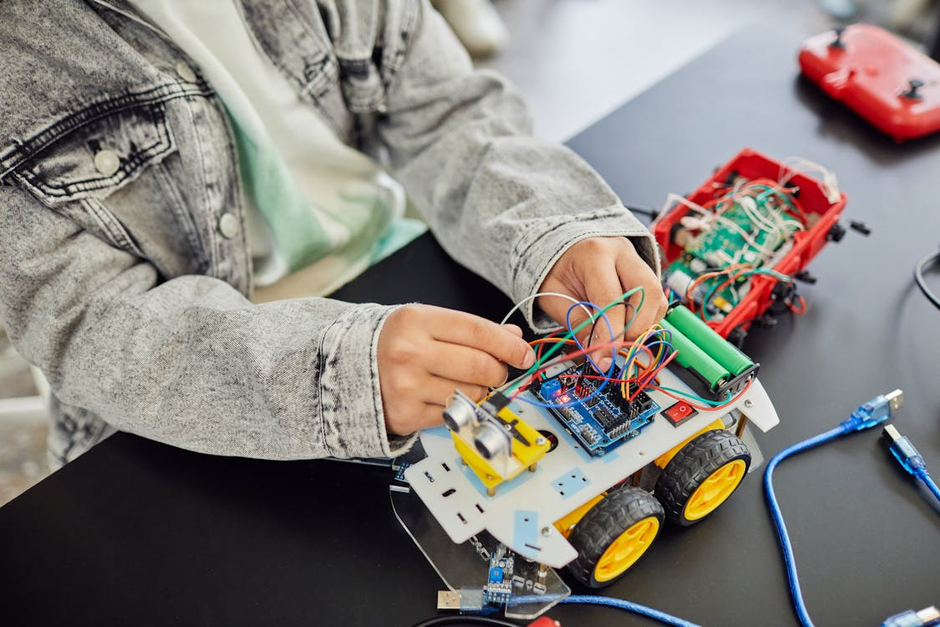
What a wall actually teaches
When a robot hits a wall, the child has to decide: is the wall the problem, or is the code the problem? That's debugging. That's the cognitive move that separates someone who programs from someone who copy-pastes.
The wall is honest. It doesn't give partial credit. It doesn't say "close enough." Either the sensor triggered or it didn't. Either the robot turned or it hit the wall again.
That friction — the wall, the failed circuit, the sensor reading wrong — is where real learning happens. Not in the moment of success. In the moment of "wait, why didn't that work?"
So where does coding fit?
Inside the robotics work. It always has been. The child who builds a robot is writing code within six weeks. The difference is they write it for something that moves, something that fails, something they can pick up and turn over and inspect.
Code on a screen is abstract. Code on hardware is immediate. The concept of a variable is ten times easier to understand when changing a number makes a motor go faster.
My honest recommendation
If your child is under twelve and you're choosing between a coding app and a robotics program, choose the program that involves hardware. Not because coding doesn't matter, but because robotics teaches coding better than most coding classes do.
If your child is fifteen and already knows what they want to build — a game, an app, a website — software-first makes sense. But most children at nine, ten, eleven don't know yet. They need to touch things that fail before they can appreciate things that work.
Come see what a first session looks like. Book a free demo. We bring everything.
Frequently asked questions
What is the difference between robotics and coding for kids?
Coding teaches logic through a screen. Robotics teaches the same logic through hardware that moves, fails, and has to be fixed. The feedback is physical — a robot driving into a wall teaches debugging faster than a character sliding sideways on screen.
Does learning robotics teach my child to code?
Yes. Children in our robotics program write real code — Python and block-based languages — within six weeks. The difference is they write it for something that responds physically, which makes the concepts stick faster.
Which should my child start first — robotics or coding?
For children under 12, start with robotics. The physical feedback from hardware makes abstract programming concepts concrete. Older children who already know what they want to build can go software-first.
Are coding apps like Scratch useful?
They introduce sequence and logic, which is useful. But they operate without consequences — a mistake makes a cat slide sideways. Robotics operates in the real world, where a mistake drives a robot into a wall. That difference matters for how deeply children learn to think.